Graph data structures - Searching

Previously we looked at an introduction to graph data structures and designed a very basic Graph implementation.  I also mentioned that the main things we would likely want to do with a graph is search/explore the graph.


There are two primary tools that we will use to explore graphs - these are basic computer science concepts, and should be familiar to everyone who has studied computer science at uni and faced graphs before.


Depth First Search (DFS) 
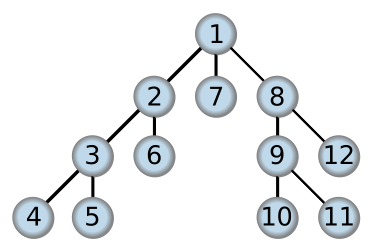
The concept behinds DFS is that given a starting point or root node, we will
search as deep as we can one route before backtracking (e.g. select a neighbour to the root node, visit that neighbour, then select a neighbour from that node and visit - continue this until we reach a node that we cannot follow any more edges from, and then backtrack up the graph considering alternate neighbours at each step)


DFS is pretty simple to implement and nataurally uses a Stack data structure to keep track of the backtracking (the easiest way to do this is to solve recursively using the implicit Stack)

Below is a simple Java implementation of DFS using recursion to handle the backtracking.


Breadth First Search (BFS)
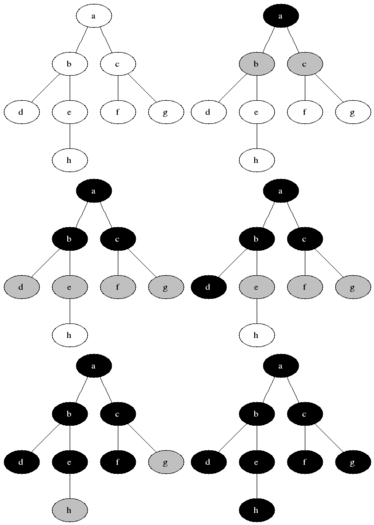
This search takes the different approach of looking as wide as possible before moving down a level. For example, we will visit all the immediate neighbours of the root, then select one of the immediate neighbours and visit their immediate neighbours - then backtrack up to visit other neighbours at this level.


(image also from wikipedia)


BFS is also fairly simple, and pretty close to DFS but it uses a Queue (FIFO) structure rather than a stack to visit nodes from the root down first.  Below is example code of BFS implemented in Java.


Graph data structures - An introduction

With most problems it is largely pretty clear which data structure is going to be appropriate to use - If you just care about storing a list and iterating over it, then you probably want an Array based structure - if you particularly care about the elements being unique you could look as a Set. If you want to capture a key-value pair dictionary data structure then you can use a Map.

Graph data structures are no different, and are very applicable to a subset of problems, and once familiar with graphs and the common algorithms it becomes quite easy to quickly identify the problem type as a graph problem.


The basics

A graph has two main elements:
  • Node - a given data point in the graph
  • Edge - a connection that joins any two Nodes. A graph can be "directed" or "un-directed" - this simply determines whether the Edge goes both ways or is purely one way. 

A graph is a data strucutre that stores a set of connected elements - the easiest way to understand the structure is with a real world example, the most famous is probably like the social-network graph. If you think about your profile on any popular social network (Facebook/LinkedIn/etc), your profile is a Node in the graph, and each of your friendship/connections is an Edge to another Node in the graph

A while ago, a Facebook intern created a visualisation of the Facebook social graph around the world - you can't really make out the individual Nodes/Edges, but you get the idea.


In Facebook's graph, it is un-directed, that is, when you become friends with another Node in the graph the relationship goes both ways - you are their friend and they are yours.

Twitter, however, is a directed graph - once you follow someone an Edge is created between your Node and theirs, but they don't automatically follow you as well, so the Edge has direction.


If you are a LinkedIn user, you may have noticed whilst browsing another user's profile a widget saying something like

"X of your connections can introduce you to someone who knows Y"


What LinkedIn is telling you, is that the shortest path between your Node and Y's Node in the graph is 3 Edges (3 "hops" - following an Edge between nodes is often called a "hop") - To be able to do this, LinkedIn is searching the social graph space to discover the shortest path (and number of unique paths that are of the shortest distance) between you and this other user.


Graph representations

There are two primary graph representations:
  • Adjacency Matrix - This is a matrix/2-D array that captures the relationship between every node. Every node is mapped against the X and Y axis, and the value in the intersecting cell determine if their is an Edge between the nodes. E.g. if we wanted to know if there was an edge between Node "4" and node "13" we would look at matrix[4][13] - the value there would tell us. Normally, value of 1 represents an edge, but other values can be used (for example, if it is a weighted graph the values could represent the weights, or if it is a directed graph it could use -ve/+ve values to represent direction).  This representation is good for "dense" graphs.
  • Adjacency List - This representation is simply a List of all Edges and a List of all Nodes. This is a simple representation and is more memory efficient for "sparse" graphs

For the code samples here, I will focus on the Adjacency List representation


Graph representation - Java

Below is a very rudimentary implementation of a Graph class in Java. It uses a Adjacency List representation and will be used in later examples I go through.


Below is a sample unit test setup that shows how a simple graph can be initialised:


In the next post I will go through basic techniques for searching and exploring graph spaces, as well as a post looking at how to solve the LinkedIn shortest path recommendation problem.


Quick Sort - A Java implementation

And now the same for a Quick Sort I implemented. Normally Quick Sort also runs in O(nlogn) time, but its worth noticing that the implementation below just uses the first element as the pivot value, which is not an optimal pivot (performs very badly in partially sorted lists for example), so will leave it to you to think about better ways to choose the pivot value.


MergeSort - A Java implementation

I wrote a Java implementation of Merge Sort a little while ago, just for fun really. I was just about to close the file, noticing it was still open in my IDE, and thought I might as well just post it here quickly. It might be interesting for someone along side the Merge Sort analysis I previously wrote up.


Tech cheat sheets - Maps

Also sometimes called an associative array, symbol table or dictionary - Maps are collections of key-value pairs and are probably one of the other most common data structures you might come across day-to-day.

HashMap

The most commonly used Map implementation in Java is probably the HashMap. The HashMap makes use of the equals() and hashCode() method on Java's Object API.

The basic premise is that the HashMap has a collection of "buckets", each which can hold several objects. When an object is added to a HashMap the hashCode() method on the key is used to select the bucket to use, the object is then added in that bucket.  For retrieval, its the same process - hashCode() is used to determine the bucket, then the entries in the bucket are inspected and the equals() method is used to determine the match.  In Java's HashMap, the buket is essentially implemented as a linked list (not a LinkedList - but Entry<k,v> has a pointer to the next entry)

The obvious implication of this, is that the performance is dependent largely on the design of a good equals() and hashCode() method.  For example, if you designed a hashCode() method that always returned the constant 1 (which would be legal, as the Java contract is that if two Objects are equal() then they must have the same hashCode(), but if two Objects have the same hashCode() they do not need to be equals()) - then it would mean all entries would be put in a single bucket.


The hashCode() method

Designing a good hash code implementation is very important - for performance (see this stackoverflow discussion on the performance impact of large HashMaps with poor hashCode implementations), but also if your hash code is erroneous then your HashMaps might just not work and you may insert objects in your Map and never be able to retrieve them (if hashCode() doesn't return consistent values for example, it could be placed in a bucket, then when trying to retrieve it generates a different hashCode() so looks in a different bucket).

If you know the complete key set, and it fits in to the Integer range (hashCode() returns an int) then you could design a perfect hashing algorithm that allows every unique key to have its own bucket, so guarantees O(1) time for insert/retrieve. However, in practice this is also quite unlikely, so ideally want to design for as even a spread across buckets as possible.


Performance

Due to the dependency on the implementation of the objects used as keys, and the data set, the worst case vs best case performance is varying.

Search/insert/remove - All these operations suffer the same problem - in best/average case performance these can be done in constant O(1) - However, the worst case (all elements in one bucket) the performance drops to linear O(n)

In practice, HashMaps are usually more efficient than search trees and other look ups, which is why they are very commonly used.

Tech cheat sheets - Stacks & queues

A Stack data structure is a Last-In-First-Out (LIFO) list.  There is a Stack<T> Interface, but the recommended Java structure is the Deque (another interface featuring an Array and Linked implementation).

A Queue data structure is simply the opposite, First-In-First-Out (FIFO) structure. The current Java recommendation is also to use the Deque (noramlly pronounced "deck" if you were interested,  and stands for Double-Ended Queue)

Having read the discussion of ArrayList vs LinkedList, many of the same considerations apply - but given the common use-pattern of stacks/queues, the different implementations make sense.


Deque

Java's Deque implements the Queue interface, and can be used as either a Queue or a Stack, offering methods appropriate for either use.


ArrayDeque vs LinkedDeque

Similar to ArrayList, the Array based implementation is the most popular, and, by-and-large the most recommended implementation to use.

Based on what we already know about ArrayList and LinkedLists, and what we know about Stack vs Queue behaviour, there would be a natural use for each (e.g. LinkedList seems like a good option Stack/LIFO - we can easily add to the list by adding new objects to the front of the list, and then popping objects off the stack by removing from the head of the List - both operations O(1) - compared to the cost of adding to the front of an ArrayList that requires a lot of copying ).

However, in the ArrayDeque implementation it is a circular array - so no copying is required and add/remove is a constant O(1), and the LinkedList implementation creates a very slight performance overhead by using additional memory creating "nodes" for each object in the list.