Showing posts with label startups. Show all posts

Mobile: Web vs Native (again)

It seems like by now, pretty much everyone has weighed in on the native vs web conversation for mobile development, and being as I haven't yet, I thought why not? The age-old question being, should you make a native mobile app or just go with a standard responsive website? (or just use some common technology to wrap up your mobile website in an app).

The reason that I started thinking about this again was because an article as circulated at work, which seemed to be saying that you should do both native and web, as they have different strategic values - which, whilst I largely disagree with that, I think the underlying point being made was that there are different reasons for going down either path.

A quick caveat:

I will get this out the way up front - I'm not talking about any scenarios where you are in a very mobile-centric business - so if you want to make use of phone hardware like camera etc, or you are specifically a mobile-first type app, or one that is intrinsically linked with the mobile as an identity, then yes. Native is the only option.  This discussion is more for normal existing businesses that might (or not) already have a website and is at the point of inflection of whether to  build a native app or not11.

--- 

So, native or responsive web?

My general rule of thumb is as follows: Don't go native.

You would be right in thinking that's a fairly sweeping rule. But I think probably fair - and whys that? I think there are two primary concerns that make the cost and effort with building a native app not worthwhile:

1. Discoverability

The web is a great place for discovering things - just the word "web" portrays it quite nicely, from any given point there are undoubtedly loads of little threads(I'm talking links) that could be followed at no real cost - assuming it's not a dodgy looking link, the barrier to prevent someone following a link is practically non-existent - So you read a nice featured article about a new company/product on a blog, at the end of the article they link to their site, you click it. I mean, why not right? if it ends up looking crappy the back button saves you and what have you lost? a few seconds? Easy.

This is something that is clearly missing in the mobile app eco-system - assuming you aren't some behemoth of a company that millions of people want (or need) to interact with, a mobile app isn't going to help increase your customer base. Sure it might give you a richer experience for the handful (I'm talking in web scale here) of customers - but its not going to help grow customers, it will cost you time and money to produce/maintain and that's before you start having to work on directing existing customers to your mobile app:

So again, if you are a bank, who has millions of customers who have specific, regular needs to transact with you, or if you are a hot new social-local-sharing company then sure, go for that enhanced UX.  But an app is only going to be any good if the users already have the intent to transact with you. If a user is browsing the web on a mobile, your conversion rate is going to be a lot higher with a link through to a responsive website than to an app download.


2. Scalability

For me, this is the deal breaker. I'm not talking technical scalability - will your servers be able to withstand the un-doubted, soon to be approaching, mass of people who will rush out and download your app as soon as its released (see my previous point), I'm talking customer-to-app scalability.

Imagine your a regular business - you have thousands of happy customers, maybe your website even gets tens or hundreds of thousands of uniques a day - so lets build an app right?

The problem is, there is a limit to how many apps that a user will have on their phone - on a standard android phone you will likely have two screens worth of app icons when you un-box it, so there is a limit to how many more apps they will install - Again, this is how it is not like the web: visiting a website is free, but there is a much greater barrier to installing and keeping an app (let alone using it) - and when the phone is getting full, or sluggish, or the user wants a bit more space to download a show from BBC iPlayer, then the apps that aren't regularly used are going to get the chop.

When you are competing with limited resources and the big players - Facebook, messaging, banks, geo-based stuff (maps, uber etc) - then it's hard to make a compelling case for the phone user to keep or even install the app.  This demand makes it even harder to convert your loyal web customers to mobile - and weighed up against the fact that you could make an awesome(and consistent) responsive web experience, the choice looks more clear for me.


Benedict Evans says you should build an app if people are going to put your app on their homescreen, which seems like pretty sound advice - and given the size of a a phone homescreen, this makes for fairly few companies.


Final caveat:

If you are building the app because it came out of a side-project organically, or a hackathon or something similar, then by all means - there's lots of fun to be had and lessons to be learnt in building, testing and launching a mobile app - so if you don't mind the potential cost then definitely go for it!


Innovating towards the traditional - Facebook & Amazon

Just a short post now - and really just two observations/trends I have commented on before that are continuing their trajectory.

Amazon bring grocery delivery to the UK - Announced today, Amazon will be bringing their "Fresh" service to the UK, starting with London and Leeds - continuing with my previous observations on innovating towards the traditional.

Facebook messenger no longer needs a Facebook account - this is older news, and I have been meaning to comment on this for a while. Basically, customers can now sign up for and start using Messenger without an account, just using a phone number, which is an un-surprising move towards phone as identity and recognising that the phone has the potential to be a node in any social connected network on the platform (much like I have preached about before..).  It is also another step towards Facebook moving further down the stack and more directly competing with native messaging apps as a system level.

Nerdability: A retrospective

In 2011, I came up with the idea to build a web based platform that lets developers and technologists build better CVs.  The idea was that as a technologist, we have a prety big online footprint that represents our skills/interests/experiences much more than a traditional CV that just rattles off academic achievements and work experience.


As a technologist applying for jobs, I wanted to make my CV stand out, and figured I have a StackOverflow profile that could demonstrate my knowledge & communication skills, I had Google-Code/GitHub/BitBucket projects which showed examples of my code, OSS contributions, technologies I have used plus then LinkedIn, blogs, Coursera courses, Geeklist.. the list goes on - and more importantly, these were things that were all changing much faster than my traditional CV was.


On the flipside of that, as an employer trying to recruit technologists is really hard - CV screening doesn't rule out many candidates, and beyond that you are left to navigate technical tests & interviews which are fraught with difficulties in trying to really assess whether someone is actually fir for a job.


Nerdability started life as an idea that was entered in a cloud competition to build a webapp (some details here originally called NerdStar) - which it won.  I then recruited two co-founders and we re-wrote a bunch of it (originally all data persistence was mongo, but switched that to relational) and launched it to the public!


In January this year (2015) we retired the application, we had somewhere in the region of 800 users signed up (with no active/paid marketing).  We have currently parked the page and a basic user profile tour on nerdability.zz.vc and are in the process of moving this holding page back to nerdability.com.


Things that went well

There was a lot of great things we learnt/that came out of the project, here are some highlights:

We contributed to OSS - During development I created a Spring-Social implementation for Khan Academy API and for the GeekList API - both of which are now listed on the Spring site as community projects.

The content driven marketing - As mentioned, we didn't do any marketing, just a few tweets, etc - but the big win was the blog. We setup a basic blog over at blog.nerdability.com (still up and running!) using blogger for hosting and just posted tech articles - tutorial type stuff plus more link-bait-y type stuff like new years resolutions for developers, or getting hackathon projects into production - and the blog drove lots of our traffic.  The beauty was the people who visited/discovered our blog were a perfect match for our target demographic, so we just had plenty of placements for nerdability and the users just trickled in!  The link-bait stuff would give us spikes of traffic, but the tutorial/how-to stuff still drives a few thousand unique views a week.

User response - The user response was good, we had a fair few early adopters who liked what we were doing and blogged/tweeted positively about the project.


Things that were hard

Competition - The weekend we were due to launch, I got an early beta-invite to StackCareers - with an almost identical value proposition, but they already have money and a massive developer community.

Two-sided marketplace problem - so we started getting users signed up, but there was little engagement as users couldn't really do much with their profiles - we had not companies/jobs listed, so beyond just sharing their profile links there was not much they could do.  We were working on the company integration when we finished, but didn't get into it.


Conclusion

In the end, the three of us weren't at the right place/point in time to go into the project full time (family stuff, wrong career stage etc). However, I still believe there is a good business model in the idea, and still think that even if it was setup today it could be successful.  Despite the community and backing of StackCareers, I don't think they have really nailed it, and seem to have stagnated at a slightly improved jobs board - but not really using the intelligence/information to really improve the recruitment process and take any burden of employers/interviewers (which is where I think one of the big wins is for the model)

The joyless world of a data-less startup

I recently read "The Joyless World of Data-Driven Startups" over on medium.

It's a nice article, and there are plenty of good points made - but my concern with the article is that it champions data-less decisions without covering the times when data-less or gut-instinct decisions are not appropriate.  In many ways it mirrors some conversations I have had over the past year or two regarding the benefits of data and using the Build-Measure-Learn approach from the Lean methodology.


I actually think the article hits the nail on the head, but really this post is to address the fact that some people may read what they want from it (and use it as an excuse not to measure).  I think really, the main take away point from the article is this:

Data-driven innovation sucks.

That is really what is at the crux of the article, using data to drive innovation is as close to paint-by-numbers as you can get.  Think about it, innovation is by its very nature a creative process - its the act of creating something new, or something that tackles a particular domain or problem in a new and original way - obviously not something that can be done formulaic-ally by numbers.  Creating a new and exciting product has to be creative by nature. Creating a clone of an existing product/service is not (that's not to say that it wouldn't still be a viable business though!).


The problem is, in the past I have ended up in lots of conversations as a proponent of Lean and the B-M-L iterative approach to attempting to better understand the solution and problem domain and have faced this very argument - that its OK that we aren't measuring result correctly(if at all!), and its OK that we are releasing multiple changes, and pulling lots of levers, all at once (thereby making data we do measure difficult to tie back to single changes), because just look at Steve Jobs! He didn't bother about asking what users wanted! he just gave them his vision!


And that is the main distinction I would like to highlight - there is a big difference between using data to drive your creative/innovative decisions and using data to learn from your innovations.  Yes its OK to be creative and out-of-the-box with innovation and new product features - that's how we got so many amazing products that we have today - but you need to be ruthless in your learning and understanding of the data.


To the Steve Jobs example - yes, he was a visionary and he ignored data/user research when designing products - Jobs/Apple are famous for their approach of just giving customers what they decide they want, and with great success - but they still use the data.  You think if the iPhone was a dismal failure they would have ignored that data and not changed it? You think Apple haven't killed off products that haven't performed well?  These are fairly extreme examples, as in both cases the data is very visible (e.g. sales figures) that people might not think of as post-product learning, but really its the same thing.


Essentially, the bottom line is whilst data-driven innovation sucks, data-driven learning is essential.

That's my opinion, anyway.

Technology, innovation and 2015

There has already been several people, much smarter than me, offering predictions for the next year (my favourite is Fred Wilson's look back at last year and look forward to the next) which you should probably read rather than mine, but here we are anyway, so lets go with a few thoughts on 2015 and onward..


Television

I have written about this for a while, and the battle for the living room will continue to rumble on. I'm not sure if we will start to see one or two winners fighting it out this year, but I can only see this area getting more interesting.  NetFlix, Amazon Instant, NowTV have established themselves as the more dominant on demand providers but that is only a part of the battle - there is still the problem of platform fragmentation (no common platform across devices/TVs/etc to run consistent experience apps - some devices not being able to support updating OD apps etc).  Android has a real opportunity to tackle this problem, given that pretty much all content providers already support the Android platform in smaller sizes, but let's see what they do. If they can become the defacto television/set-top box OS it would be a big win for them, but would also mean that device manufacturers & content providers don't need to worry about building & supporting their apps for a range of platforms and can focus on building the best experience on a single platform.

There is also the question as to the role of the actual TV device - will it be a smart device with a dedicated platform, or will it become dumber that just streams content from any other mobile device.


Enterprise

There has been some hype around Enterprise startups growing over the last 12 months, and this will also slowly increase - as has always been the way with enterprise, things have been very slow in terms of adoption and businesses and executive teams generally very wary about adopting new technologies until they are really widely adopted and proven - but this is starting to change. As more and more areas of business are starting to be disrupted by upcoming startups, more established businesses are starting to adopt technology more quickly to try and stay in the game, and more and more starting to spin off departments/teams from the business to operate as micro-startups to help drive innovation.  I think with this trend for bigger businesses becoming more willing to adopt new tech continuing, we will see some big noise in the enterprise/SaaS areas.


FinTech

Similar to wider enterprise trends, the banks and financial institutions are starting to become more aware of the risk and trends in their business with more and more people starting to expect better/different ways to do business.  From the larger tech of Bitcoin through to ApplePay, Square etc I think we will see continued innovation and surprises from the bigger players as well as a whole host of startups snapping at their heels.  With London currently the world FinTech capital it could be an interesting year here.


Education

This is an area I am interested in and have written about on a few occassions. I'm not sure this will really be a big area in 2015, there certainly aren'y any startups I am aware of that look like they might make really big waves in the year, but here's hoping.  Either way, there are still interesting things going on - there is the continued change in the UK curriculum with things like the "hour of code" and the continued drive to put more tech on the curriculum. Plus, I have recently spoken to two startups recently that are doing interesting things in the education mobile app space: Zzish and kahoot  - they are both working on mobile app/web platforms for the classroom with a bunch of tools to help teachers and children learn and work together.


The rest..

I agree with many of the other observations on Fred Wilson et al's writing - continued growth, acquisitions and big IPOs from the current crop of big startups will continue (AirBnB, Uber etc).

Companies like Xiaomi will continue to grow and hopefully come and start to be real contenders in the western markets (even if the Xiaomi laptops have been leaks, I'm still interested to see if they do come with a laptop anything like the leaked specs.. could get interesting!)

As Fred Wilson mentions, and as I have previously written, I don't think wearables are really ready to be a thing. Still more work needed on how these will fit into the market, and I don't think that will be happening in 2015.


Yo: One reason it doesn't suck, completely

There has been a lot of talk about Yo recently. Initially it seems like the talk was all driven by the fact that this seemingly pointless app had raised $1million in angel funding (a good way to generate publicity and hype I guess if you happen to have a milli lying around). A lot of people speculated this as further proof of the tech bubble they had been long predicted. Others just talked about how crappy it was (albeit indirectly)

At a glance, neither the app nor the funding round seem particularly interesting - The app sounds distinctly like a novelty app that has only generated interest (and therefore users) on account of the funding, and seems destined to be a blip in the tech-history books much like Chat Roulette etc (although I can't really see it hitting he heights of Chat Roulette - at least people still make an occasional joke about Chat Roulette - I think give it three months and no one will be talking about Yo). The funding is less interesting when you hear the full story: according to Forbes, the app was created by a chap called Or Abel, after his former boss, Moshe Hogeg apparently asked him to make the app so he could buzz his PA without having to call, when Or Abel then switched up the idea a little bit Moshe lead the funding round (so a guy invested in what was basically his own idea, probably wasn't the world's hardest pitch).

Context based messaging

One reason cited for the app not being that lame, is apparently that it is actually trying to fill in a gap - providing context-based-messaging e.g. when you ping someone a "yo" they know the context of the message so you don't need to know anything else.

I don't agree. At least with the examples cited so far, it still seems pretty lame. The main example that has been used is the World Cup - you could subscribe to WORLDCUP by yo-ing them and then you will get a "yo" back everytime a goal is scored. Which honestly doesn't sound that great. I have been following the WC pretty avidly, but getting intermittent messages saying someone scored doesn't sound useful, and the main problem is that I would then have to launch another app to actually get the context (e.g. which team scored).  There are lots of other solutions to this that provide simple notifications including the context.


Some other examples:

Wanna say "good morning"? just Yo. 
Wanna say "Baby I'm thinking about you"? -- Yo. 
"I've finished my meeting, come by my office" -- Yo. 
"Are you up?" -- Yo.

These all make sense, but what next? How do you continue the conversation? how do you confirm/agree that all important context of the message? All these simple "yo"s all drive users to other apps - which means more effort/taps so why bother starting the conversation in Yo at all? why not just use WhatsApp/SMS/Facebook/GChat/etc from the start?


Ok, so clearly Context-Free messaging is a bad idea..

However, in my opinion, there is a glimmer of hope for the app, but the question for me is really just does it have enough runway to execute it before it just becomes another novelty app in the history books.

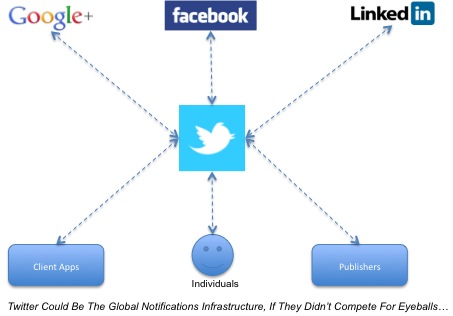
A few years back, just before Twitter went all dick-ish with their API and started locking out the entire developer community and third party eco-system there was a few good articles discussing an alternative business model for Twitter, and rather than becoming a media company (that it has become, rich content including pics/videos & trying to drive all eyeballs onto twitter.com or official apps - not via third party clients) it should become a global messaging system - it had the infrastructure made to be a massive pub-sub/notification system (I think at the time there was a better article that I read, but can't find the link now, so that one will have to do - if anyone thinks they know the one I mean then please add to the comments!).


This is a space that I think Yo could step up and fill. And its possible that they are thinking the same - having already announced their API, they already suggest some simple notification systems that could utilise it - In which case, it could become a really interesting platform.


So who knows, there is potential for it to become something pretty neat. Odds are on it will just end up a passing gimmick though.


The Idiot Box: Disrupting TV

There has been a lot written in recent months about the changing role of content on the web and devices, particularly recently with Apple's acquisition of Beats (things just aint the same for gangsters) - and Benedict Evans recently wrote questioning whether content is actually still king. And I think we can agree he makes a good point, when it comes to music, it is no longer a USP, its just expected. Between YouTube, SoundCloud, Spotify, Google's Play services etc there is no reason people can't just stream any music they like, fairly seamlessly, and switch between providers/apps just as easily.  Apple had invested massively in iTunes, but the iTunes buy-download model isn't what people want any more (hence buying Beats, actually for their streaming service maybe).


A more interesting area is Television - content is still a key factor, NetFlix, Amazon Instant(formerly LoveFilm) etc are largely compared entirely based on their content - as a service there is little between them, other than content.  So really it's no suprise to see all the normal big players getting involved in the market Google (ChromeCast etc), Amazon Instant, Apple TV.

Within 5years I think we will see a massive shift in viewing patterns, with pretty much all new TVs sold today being web-enabled I think its an inevitability that people will move to all on-demand services rather than being dependent on scheduled programming. Within a further 5years I wouldn't be surprised if scheduled programming was all but dead and gone.

We recently bought a NowTV box - at just £10 its a pretty low barrier to web-enabling your TV - and we have pretty much switched over to entirely on-demand service - despite having a PVR we still go for the on demand options.


I think there will be some interesting things that come from this:

Platform Fragmentation

I think this is the biggest problem facing the market at the moment, and to me looks like a massive opportunity. At the moment there is so much fragmentation across the platform: Playstations, Xbox, Android, iOS, TVs (Sony, Samsung, etc) - all have their own platforms, and any on-demand service that wants to offer an app on every platform needs work from either the platform owners or the service providers - if its the platform owner then the provider looses control of UI/UX app features and consistency across platforms, and if its the service provider then they have a lot of work to do to support the different platforms, and they will inevitably have to make decisions whether or not to bother with each platform.

At the moment, in the UK, if you buy a web-enabled device then you can't guarantee that it will have the basic UK free-to-air OD services (BBC, ITV, Channel4, Channel5) - When I bought the NowTV it didn't have Channel4 apps and still doesn't have ITV (and that's a platform backed by BSkyB, which is a fairly large organisation and platform). There are already some Sony TVs that are no longer supported and provider apps are no longer being developed/maintained/supported. 

Android and iOS aside, all platforms will suffer this problem - that is until someone comes with a platform standard/OS that is open and can be re-used across devices. And given Android's prevalence, and Google's investment in TV it would seem like the best placed candidate to tackle that, but let's see!


What is driving creation production?

With scheduled TV there are quiet times, early hours of the morning, working week daytime - and content is created for that specifically. Providers have to each fill their schedules for these hours, so these are commissioned/bought/run.  However, if scheduling was to end, and it was all on-demand then would people still make this content? I'm sure there will still be a demand for some of this content, but people who watch it just because its on will obviously diminish. Students in the UK have had a tradition of watching daytime TV, whether it be Countdown, Diagnosis Murder or Quincy - but in the era of on-demand why would they search out this content? 


Ideas

So this is just a quick note on some things that I am personally finding really interesting right now

Education 

as mentioned, I think this is going to be cracked soon, and maybe Khan academy will do it. Either way, I think whoever does it would need to be a "full stack" startup. I have thought about trying some things - like a GitHub type system for open-sourcing education materials and resources, creating open-standards for curriculum and educational texts etc - but they have always just been tools or things around the periphery. I don't think I have the resources right now to be thinking full stack!


Android first

Android is the most pervasive mobile OS (yes, there are some caveats about the stats, such as numbers coming from China, and the value of the customer compared to other iOS), and Google continue to widen their reach (recently purchasing Nest etc) I think we are going to seeing our first truly Android first apps. If Instagram was built today, would it be iOS first? Probably, but I think that landscape is changing. I think coupled with the following areas this could be a big one.  If I'm building a mobile app it's going to be Android first. Silicon valley is under-invested in Android - There is also growing appetite for it:


Smartphone as your social graph

I have mentioned this one a few times here. Smartphone usage is continuing to increase (even whilst tablet sales falter) and more and more existing mobile users across the world upgrade. Further to this, your smartphone is really where you social graph is. Your address book has your contacts in it, your phone number gives you a unique identifier, and as WhatsApp proved, it gives great power to mobile first startups to disrupt the social network incumbents. It could be argued that Google+ was never going to succeed to usurp Facebook as king of the social networks because people are lazy, and essentially creatures of habbit - if all your friends are on Facebook, why try to convince your entire network to switch to g+? But the smartphone takes away that power, as your network is on your device, not a particular platform.  Couple that with the fact that so many use their phones to double up as cameras it now means most of our photos/videos are also on the device.

Television

I was recently talking with some colleagues about the future of TV and I speculated that in 5-10 years we may see the end of scheduled television, and everything will be only on demand. This would leave some interesting questions/problems:

  • One big problem as I see it is the fragmentation of device software - if you are creating an on demand app, you need to think about Android, iOS, browsers, Xbox, PS, not to mention all the TV manufacturers that have their own software running on their web enabled TV. This means at the moment, if you buy a new web enabled TV or set top box, the on demand apps may not be available, and may not be consistent. I think this could be a good market for Android and wouldn't be surprised if they do make some bold moves in this area (yes, bolder than Chrome Cast) - I would think it would make sense for them to be linking up with TV manufacturers to as the de-facto TV OS (would benefit from android app eco system - even if it would mean a LOT more work for app developers to fix up for another range of screen sizes
  • Another interesting implication of such a switch would be would we see a decline in produced content. At the moment there is a lot of content created specifically for quieter times of the viewing schedule (mon-fri afternoons, early morning, etc) - what might be considered as "filler", but we might see a decline in this as consumers will have complete control of what they want to watch, and there won't be any watch it because its on mentality.
I think its an interesting areas where battles are really going strong, with big players in the content production/distribution space (Netflix/Amazon/YouTube) as well as Google/Apple etc taking on the incumbents in hardware.  I just today saw a link for a site called Glass that is dedicated to ongoing conversation about this topic.

Observations on the WhatsApp Acquisition


Yesterday's acquisition of WhatsApp is a great example of a few trends throughout the industry:

1) The importance of product

WhatsApp currently has 450 million active users, double that of Twitter, and is still growing at an insane rate (which probably hurts even more given Twitter's recent growth struggles), why is that? Sure, in no small part it is because they are the first major company to really disrupt and take on the SMS/MMS monopoly - Why ever pay for text messages through your provider if you can send pictures/chats to anyone in the world for (essentially) nothing? - but their success in becoming that major player is their single focus on the core of their product, they wanted to provide mobile messaging - and thats what they focused on. As users grew they could have spun out with gaming/video chat/desktop clients/etc but they stayed focused on their core product and did it well.

It is telling that founder Jan had this note stuck on his desk:
No ads!
No games!
No gimmicks!

Also, choosing to monetise by annual subscription rather than in-app adverts showed dedication to the statements above - having used pricing as a way to throttle growth to a rate they could manage, they grew confident that the model would work and didn't need to detract from their product with  gimmicks or ads.

Whats more, by focusing on the simplicity and usability of their core product, it also meant they could focus on the technical stability of their platform -  I doubt if they had spun out they would have been able to maintain their impressive tech stats - 32 engineers, 450million active users, 99.9% uptime.  Twitter's "Fail Whale" was infamous during their period of growth as their platform couldn't scale to handle it, but with a more accelerated growth WhatsApp's simplicity has allowed them to maintain 99.9% uptime - failing to keep platform stability could have easily seen them lose their position in the market and not be signing the deal they have.


2) The importance of mobile

Mobile is the platform of growth for the future. We are, and will continue to see more and more mobile-first (if not mobile only) startups. Instagram, Snapchat, WhatsApp - the three biggest recent startup exits - all mobile focused.

And should we be suprised? Let's have a look:
  • On average, people use their phones 150 times a day
  • There are currently ~1 billion people using smart phones
  • But, there are still ~6 billion using feature phones - so huge room fro growth

Smartphone usage has exploded, other mobile computing is growing as traditional computing devices decline.  There is a huge market opportunity for new mobile users, and for many parts of the world, mobile is providing first experience of the internet.

What's more, the mobile eco-system is offering a new opportunity for startups to take on social incumbents - For a long time, Facebook has had the crown of social, and could not be tumbled by others efforts, primarily because it's where people are. It's where people's photos are. It's where people's social graphs are. Sure Facebook's design is kinda clunky now, and kinda ugly, with terrible ads all over the place, but who is going to try and convince their entire social graph to move?  Exactly.  But the mobile eco-system offers something different - your mobile device contains your contacts/address book, your photos, your videos - more and more, your mobile device is becoming your social platform that really holds your social graph.


Mobile is the future.

Looking for a new job? with an awesome high-tech/startup?


I have just been involved in launching a new site called http://nerdability.com

The site is a new place that allows us decent, hardworking tech folks to build real, representative resumes to help cut through the endless crap that is so often the tech recruiting process.

No one is really at fault with the problems in the current recruitment process. We know it's really tough to hire tech people, as its a specialist skill blended with a touch of creativity and art, so how in the world can a potential employer/recruiter realistically asses whether we can actually do what we claim?  Enter NerdAbility. NerdAbility is online resume builder that allows users to sign up, and then connect their resume with their blog, stackOverflow profile, GitHub account, etc - the end result being you have a living CV, everytime you get up-voted on StackOverflow, or commit to an open source project you are working on in GitHub, it gets reflected in your resume. So now, you can share a resume (all users have a publicly facing url that they can tweet/facebook/email to recruiters) that really shows what you have achieved, and employers can go ahead and see your code you have commited, or see how you solve problems by your answers on StackOverflow.


There are of course plans to continue building the product, including further code repository integration, but also an opportunity for companies to make profiles and start pitching to you why you should want to go work for them (plus of course, they will be able to list job openings).

It is open to everyone worldwide (y'all know how the internet works) - but being as we are based in London, we will be first targeting the UK and Europe to get wicked-cool startups and hi-tech companies on board.


All in all, we think its pretty ace.

So come on over and join the party

http://nerdability.com